the blog
A place for our team to share about topics they are passionate about, in hopes of allowing you to see and understand a bit more behind the faces on these pages.
Adoption is not a Fairytale
To be considered “adopt ready” in Ontario you are required to take the Parent Resources for Information, Development and Education (PRIDE) course and have a licensed professional complete a SAFE home study on your behalf. As an adoptive parent and adoption competent therapist, I can confidently say that while this is a good start, adoption requires on-going learning (and un-learning!) to foster healthy relationships, healing and attachment within a family.
Throughout this series I will be intentional in my language, reflecting my understanding and learning from adoptees and birth families, but it is important to note that ultimately individuals will have a preference for words used to describe them and their relationships. As an adoptive parent and therapist I have been challenged by my own bias and misconceptions around adoption. I often think back to when my husband and I were first considering adoption and I chuckle at how naive we were. We viewed adoption as a singular event and could not have imagined how the trauma and impact of adoption would weave its way through our lives and impact us and our children so deeply.
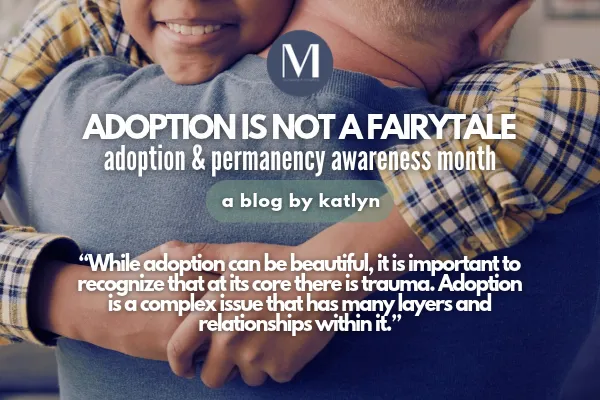
While adoption can be beautiful, it is important to recognize that at its core there is trauma. Understanding that even if a child is adopted as an infant they can still carry trauma from experiences or exposure to substances while in utero or from being separated from their biological parents is an important concept to grasp as adoptive parents or someone who knows or works with members of the adoption constellation. How this trauma manifests can vary from person to person. While studies have shown that adoptees have higher instances of mental health challenges, the research is not definitive if it is due to genetic or environmental factors, or from being adopted.
Adoption is a complex issue that has many layers and relationships within it. Michael Grand, a clinical psychologist, coined the term adoption constellation to capture the many relationships that are connected through an adoption. This can include birth parents, adoptees, adoptive parents, siblings, close friends, extended family and more. Throughout this blog series I will share more about how the adoption constellation can be impacted by adoption and what we can do to support people in our lives who have been touched by adoption.
I will close with a question to think about, especially if you are a hopeful adoptive parent:
What do I believe about adoption and where do those beliefs come from?

© Marquis Counselling & Consulting | ALL RIGHTS RESERVED | TERMS & CONDITIONS | PRIVACY POLICY