
the blog
A place for our team to share about topics they are passionate about, in hopes of allowing you to see and understand a bit more behind the faces on these pages.
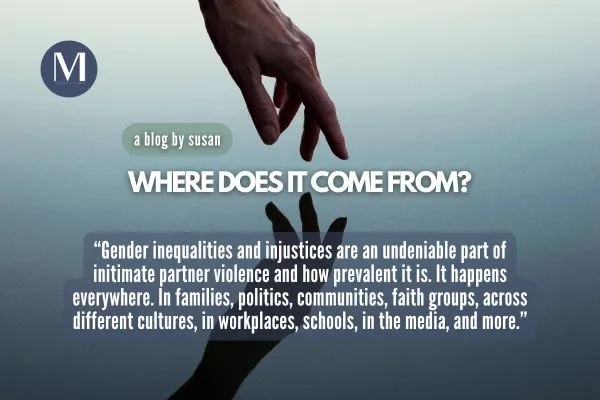
Intimate Partner Violence (IPV): Where does it come from?
It was believed for a long time that Intimate Partner Violence (IPV) was a private matter to be kept behind closed doors. In the 1970s and 1980s, more advocacy increased awareness that violence between partners was a public, not just a private, matter. The late 1980s brought about a shift in the landscape of IPV where police were required to lay charges in domestic disputes in an attempt to reduce survivors having to initiate charges. This brought the number of occurrences down between 2009-2014, but violence in relationships continued to remain high.
Now if we fast forward to 2020, the pandemic saw an escalation in IPV due to the economic vulnerability that many faced. The lockdowns meant that people couldn’t have their usual outlets, or social supports and partners were having to spend much more time together, even though abuse was taking place. As of late 2025 over 100 Ontario municipalities have declared IPV an epidemic, which means it is becoming more and more widespread.
IPV includes a huge element of power and control, which includes intimidation, emotional abuse, using isolation (from friends, family, children, etc.), minimizing, denying and blaming the other for one’s abusive behaviour, using the children or coercion and threats. IPV is rooted in power and control. This is where things can feel subtle. Control over finances would be something that an outsider would find hard to identify, and like many forms of power and control, such as coercion, aggression and other controlling behaviours, it can happen behind closed doors. These are also the very things that can keep partners in the cycle of abuse, because they do not have other supports for housing, childcare or community resources, to name a few of the barriers that survivors of abuse face. Shelters are beyond capacity, and for many they can’t share that they are in an abusive relationship because they share the same friends as their abuser, or due to cultural or religious reasons, to break the silence about the abuse would bring shame to the family and may even put lives at risk.
IPV is in no way a recent issue or a new age situation we’re finding ourselves in, it has been around since the beginning of time. Gender inequalities and injustices are an undeniable part of IPV and how prevalent it is. It happens everywhere. In families, politics, communities, faith groups, across different cultures, in workplaces, schools, in the media, and more. Colonial systems and laws, as well as other forms of discrimination all make up gender-based discrimination and it makes more groups at risk of this violence than others.

© Marquis Counselling & Consulting | ALL RIGHTS RESERVED | TERMS & CONDITIONS | PRIVACY POLICY