
the blog
A place for our team to share about topics they are passionate about, in hopes of allowing you to see and understand a bit more behind the faces on these pages.
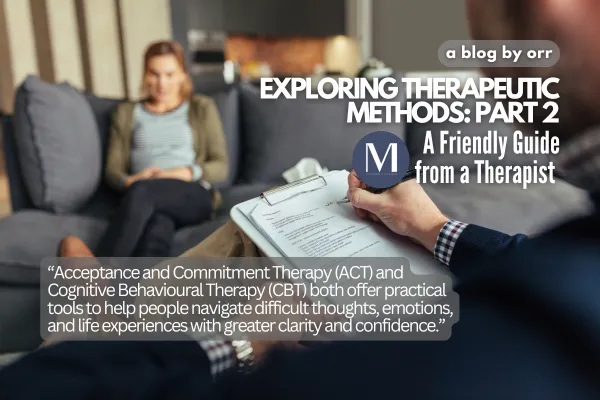
Exploring Therapeutic Methods: A Friendly Guide from a Therapist (Part 2)
In the first part of this series, we explored how different therapeutic approaches can support healing in unique ways, and took a closer look at Internal Family Systems (IFS). In this second instalment, we’ll continue the conversation by exploring two widely used and evidence-based approaches: Acceptance and Commitment Therapy (ACT) and Cognitive Behavioural Therapy (CBT). While these modalities are different in structure and focus, both offer practical tools to help people navigate difficult thoughts, emotions, and life experiences with greater clarity and confidence.
Acceptance and Commitment Therapy, often referred to as ACT, focuses on changing your relationship with your thoughts and emotions rather than trying to eliminate them. Instead of getting stuck in an ongoing struggle with uncomfortable feelings or intrusive thoughts, ACT encourages acceptance of what is outside of your control while helping you move toward what truly matters to you. The goal is not to feel good all the time, but to live a meaningful and values-driven life, even when things feel hard.
ACT can be particularly helpful for concerns such as anxiety, depression, OCD and intrusive thoughts, perfectionism, and living with chronic pain or illness. Many people find relief in learning that they don’t have to wait for their thoughts or emotions to change before taking meaningful action. Rather than avoiding discomfort, ACT teaches skills that allow you to make room for it while still showing up for your life.
In an ACT session, you’ll practice noticing thoughts and feelings without becoming overwhelmed or pulled into them. Mindfulness-based techniques are often used to help create space between you and your inner experiences. A significant part of the work involves identifying your core values and committing to actions that align with them, even when fear, doubt, or discomfort are present. ACT offers practical, real-life strategies that can be applied both inside and outside the therapy room.
People are often drawn to ACT because it feels empowering and compassionate. The approach is non-judgmental and flexible, meeting you where you are while helping you move in a direction that feels meaningful and authentic to you.
Cognitive Behavioural Therapy, or CBT, takes a more structured and skills-based approach. CBT is grounded in the idea that our thoughts, emotions, and behaviours are interconnected. By learning to identify unhelpful or distorted thought patterns, you can begin to challenge them and replace them with more balanced and supportive perspectives. Over time, these shifts in thinking can lead to noticeable changes in how you feel and how you respond to everyday situations.
CBT is commonly used to support individuals experiencing anxiety, depression, low self-esteem, sleep difficulties, and persistent negative thought patterns. It can be especially helpful for people who appreciate clear frameworks and practical tools that they can use independently between sessions.
A CBT session often includes structured exercises such as thought records, behavioural experiments, and goal-setting. Therapy is collaborative, with you and your therapist working together to identify patterns and test out new ways of thinking and behaving. Many people find that CBT helps them feel more confident in managing their thoughts and emotions over time.
One of the reasons CBT remains so popular is its strong research foundation and action-oriented nature. It offers clear strategies, measurable progress, and skills that can be carried forward long after therapy ends. For many, this sense of structure and momentum makes change feel both achievable and empowering.
As this series continues, we’ll keep exploring different therapeutic modalities to help you better understand your options and find an approach that feels like the right fit for your healing journey.

© Marquis Counselling & Consulting | ALL RIGHTS RESERVED | TERMS & CONDITIONS | PRIVACY POLICY