
the blog
A place for our team to share about topics they are passionate about, in hopes of allowing you to see and understand a bit more behind the faces on these pages.
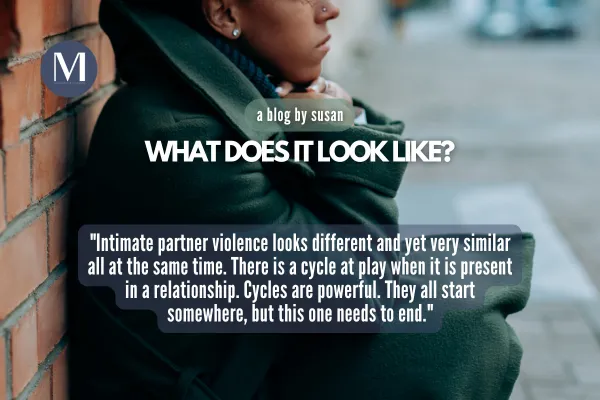
Intimate Partner Violence (IPV): What does it look like?
When family or friends hear about a loved one being in a relationship where Intimate Partner Violence (IPV) was present, there are often one of two responses. The first is that they had no idea, or that they had a feeling something wasn’t right in that relationship.
IPV looks different and yet very similar all at the same time. There is a cycle at play when it is present in a relationship, and it often starts with what is known as the “honeymoon phase.” Everyone is putting their best foot forward, including the perpetrator, and that can look like general niceties, such as holding doors open, showering their partner with love, compliments, gifts, etc. Oftentimes that phase can last for a while, before something starts to shift. Other times it’s short lived, but it’s enough to give the partner a taste of what love and care might look like. After the honeymoon phase, however, the relationship moves into the “tension building stage,” where there’s a feeling of walking on eggshells around the partner who will go on to be abusive and the partner’s stress starts to build. This is followed by the “Explosion Stage,” where an incident often occurs. The explosion, or incident, could be an act of physical or sexual violence or abuse, or emotional and mental abuse, where the abuser is highly escalated and lashes out. This is known as the cycle of abuse.
I like to use the example of a pop bottle to explain the cycle of abuse. Imagine you buy your favourite carbonated drink from the store. When you bring it home, you can open that fizzy drink, take a sip, and enjoy it – you feel “satisfied” with the drink. This would be the “honeymoon phase.” If, however, you were to put the cap back on that bottle and give it a shake, the pressure in the bottle would build, which would represent the “tension building stage.” Finally, if you were to open that bottle, after shaking it, that drink would spew, or “explode” everywhere, which would be the final stage of the cycle. Now, set that drink back down again, because there will still be some of the drink left, you can have a sip again and we’re back to the honeymoon phase – and on and on it goes. Cycles are powerful. They all start somewhere, but this one needs to end.

© Marquis Counselling & Consulting | ALL RIGHTS RESERVED | TERMS & CONDITIONS | PRIVACY POLICY